If you cannot get rid of the family skeleton, you may as well make it dance. George Bernard Shaw

Thursday, March 5, 2015

Cruse Cemetery, Tyler County, Texas, Part 1

One of the neat things about getting the book on David Crews into a second edition is the finding of new cousins. Michael Harris, a descendant of David Crews through his son Elijah and grandson Squire recently contacted me. He is the only descendant thus far from this line that I have been in contact with. He has been doing research on this family and last year took a trip to the Cruse and Segriest Cemeteries in Tyler County. It will take me several postings to relay the pictures Mr. Harris has so graciously allowed me to post here. 

According to Mr. Harris, both cemeteries are maintained. I had lamented in my 2nd edition that that last time I was at the Cruse Cemetery nearly twenty years ago the path to it was not being maintained, nor was the cemetery. It is nice to hear someone is taking care of it. 

Squire Cruse was the son of Elijah Crews and Susannah Dozier and the grandson of David Milton Crews and Annie Magee. Squire married Piety Pruitt, daughter of Matthias Pruitt and Polly Hoover. He was one of the first settlers to acquire a land grant within the present limits of Tyler County, Texas. Five of his children drowned on the Mississppi River while en route to Texas. I have an extensive chapter on him in Metes & Bounds II: David Milton Crews, Ancestors & Descendants, and will not relay that information here. 

Acceess Point from the Road

Wide shot of Cruse / Methodist Cemetery in Tyler County, Texas


Original Headstone of Squire Cruse
Original Headstone of Piety Pruitt Cruse
Squire Cruse footstone erected by the State of Texas 1962
Newer Headstone


Saturday, February 14, 2015

Mary F. Newland and John Graves


One of the frustrating things about publishing a genealogy book, especially one the size of Metes & Bounds II: David Crews, Ancestors & Descendants, is the fact that new information is being discovered all the time, and cousins are always around the next corner. These new cousins almost always know something I don't. I will likely never get to doing a 3rd edition of the Crews book, but I will be posting information on this blog that “updates” the Crews family.

Graves of John E. Graves and Mary F. (Newland) Graves
Donnelton Cemetery, Hunt Co., TX
courtesy of Mary La Rue, El Paso, TX 2015
I received an email this week from Mary La Rue of El Paso, Texas. Mary is a descendant of David Crews and Annie Magee through their daughter Mary Crews Newland. She informed me that Mary F. Newland, daughter of William W. Newland and Arthusa Bascom Randall, married John E. Graves. On page 179 of my 2nd edition, I indicate the last name of Mary’s husband to be “Graves,” but I had no record regarding his first name. Mary F. Newland was the great-great-great granddaughter of David Crews & Annie Magee.

William and Arthusa (Randall) came to Texas not in 1848, as I stated in my 2nd edition, but sometime between 1850 and 1860. In 1850, they are in the Jessamine County, Kentucky, census, but by 1860 they were in the Kaufman County, Texas census. 


Grave of Sarah Elizabeth "Lizzie" Newland - Smith
courtesy of Mary L Rue 2015

Mary F. Newland was born in 1843 while the family was still in Kentucky. She would have been a little girl when her parents moved from Kentucky to Texas. She died in 1924. John was born in 1833 in Georgia and died in 1901. They are both buried in the Donnelton Cemetery in Hunt County, Texas. John and Mary were married on August 9, 1859 in Henderson County, Texas. 

John and Mary (Newland) Graves’ daughter, Sarah Elizabeth “Lizzie” Graves, was the maternal great-grandmother of Mary La Rue. Mrs. La Rue is also a descendant of William Hoy and Sarah Callaway, early settlers of Boonesborough, Kentucky, and contemporaries of both the Crews and McQueen families. In fact, Hoy’s Station was 400 yards southwest of David Crews Station on the dividing line between Otter and Tates Creeks in Madison County.


Lizzie was born in 1866, at the very end of the Civil War, and died in 1901. She married John R. Smith. John was born in 1862 and died in 1942. Lizzie and J.R. married on April 10, 1882 in Hunt County, Texas. The picture below is of Lizzie and J.R. and their family and Mrs. La Rue believes it was taken in or near Brownwood, Texas around 1897, not long before Lizzie's death. 


Family of John R. "J. R." and Sarah Elizabeth "Lizzie" (Graves) Smith about 1897.
Children pictured are Lula, Behula, Thomas, William, and Legal  who is on Lizzie's lap.
(Legal was Mary La Rue's grandmother.) 

NOTE: All information and pictures used with permission of Mary La Rue in an email dated to blog owner February 2015. 


Monday, November 17, 2014

Religious Freedom? Not so Much

I originally published this article last May. I had very few followers at that point. Since it pertains somewhat to Thanksgiving and some misplaced traditions about religious freedom and the roots of our country's history, I thought it would be appropriate to repost it here. This is crossposted from my author blog as it contains information of an historical nature.

Contrary to popular historical thought, colonial America was not built upon freedom of religion. Not counting the lost colony of Roanoke, the first settlement in the New World was at Jamestown, Virginia, in 1607. Although this colony went through several periods of near abandonment, the colony survived enough to consider that year as its date of establishment.  This colony was NOT founded on any sort of religious pretext whatsoever, but was founded purely on England’s desire to expand its border beyond Europe and to beat its rivals, Spain and France, in founding new territories. The Virginia settlers were Englishmen and were supporters of the Anglican Church. That religion, naturally, became the state religion of the colony. In 1753, the year my novel, Keeping Secrets, opens, colonists were expected to support the church and the priests with their tithes and money, as well as attend Anglican services. Fines were levied against those who chose not to do either. 
The Pilgrims are oftentimes not only hailed as being the first colonists to settle the New World, but they are praised for their courage in leaving England to establish a country for religious freedom. Neither is the case. The Pilgrims did not land at Plymouth, Massachusetts until 1620, nearly 13 years after the settlement at Jamestown. It was, therefore, the second English settlement in the colonies, and ironically, while they left England for freedom of religion, they turned around and held a monopoly on religion much like what they left England to escape. Anyone who has read of the Salem witch trials, or Roger Williams and Anne Hutchinson, knows the kind of pressure Puritans could bring to bear on those who chose to follow a path different from their own. While they believed in freedom of religion for themselves, they did not believe in it for other people.  
1427658_41429283Unlike Virginia and the Plymouth Colony, the colony of Maryland, granted a charter in 1632, was founded by Catholics on the idea of religious freedom. Originally a haven for Catholics, by the early part of the 18th century, it had been supplanted by Protestant factions, and the Catholic Church was driven underground. Mass was not allowed in public, and Catholics never regained their primary standing in any colony. 
 In 1681, William Penn founded Penn’s Colony, or Penn’s Wood, also on the idea of religious freedom.  Penn, himself, was a Friend (Quaker), however, the Friends were eventually disenfranchised there as well despite their large numbers. Part of the problem with Pennsylvania Friends was their western border which endured a constant state of Indian wars from the mid-18th century to well after the Revolution. “Quaker pacifism,” in the face of such brutal hostilities, just didn’t make sense to the vast majority of colonials. 
The Baptists and Methodists arrived in the colonies at around the same time as the Friends. While there were other smaller groups, for example, the Mennonites and the Moravians, they were smaller and of lesser consequence than the main religious sects.  In the south, especially in Virginia, the Church of England was the established religion, so fines were levied against those who refused to participate, including Catholics, Baptists, Methodists, and the Society of Friends.
 It was within this hodgepodge of emeshutterstock_194160026rging religious availability that Keeping Secrets opens (and our early Quaker ancestors, Crews, Ladd, and Magee lived). While Mary McKechnie is a devout Friend, embracing her religion and all it entails, Amon Cayle is not. The Friends literally controlled every aspect of their members’ lives, and while devout Friends welcomed the structure, many chafed against the restraint. 
For Amon Cayle, the problem is deeper. He doesn’t believe the Friends, as a religious group, have the authority to tell him how to live. Thus, he constantly walks a fine line between raising his kids to follow God, staying in good standing within the Friends so as to honor the promise he made to his late wife, and his quest for inner peace.  Amon Cayle’s turmoil mirrors so many of the Friends at that time.

     Amon laced his fingers together and rested his elbows atop his knees. The heat from the open window warmed his back. “What happened with Jackson?”
     The boy looked away, but not before Amon caught a glimpse of shame.
    “The note from Andrew says thee picked a fight with him.”
     Still nothing.  Amon felt his temper rising. “David, if thou will not speak to me, I will have to punish you with the information I have. After last year, I will not tolerate any fighting.”
     “He said his Pa was trying to keep me out of the test so he had a better chance of winning and . . .”
     “And what?”
    “And that as long as you were a disorderly walker, he just might win.”
    “So you started a fight?”
    “No. He started it.”
    “Who threw the first punch?”
    “I did, but he shoved me into a tree.” David shifted his right shoulder forward. “Tore the last good shirt I have.”
    Amon reached up and pulled the three inch ragged tear apart to reveal a middling patch of inflamed raw skin.  That goodness it wasn’t the other shoulder.  “Tell Rosie to put something on that later.”
     “‘Tis not even my shirt. Aunt Agathy found an old one at her house and gave it to me.”
    “What’s wrong with yours?”
   “They are all too small. I gave them to John. With this torn, I don’t know what I will wear to school tomorrow.”
   Amon ran his hand along his jaw. He wasn’t going to punish the boy for defending himself, and he didn’t doubt David was telling the truth. His nephew had been caught in too many lies over the years, lies his brother always believed. 
   “What am I going to do Pa? I’ve worked my whole life to take that test.” 
   “I am seeking restitution at the Friend’s next monthly meeting. After that, I will again be a member in good standing.”
   David’s chin jerked upwards. “I don’t want thee lowering yourself to apologize to those people for me.”
   Amon thought his head would burst. “Do you want to take the test?”
David nodded.
   “Then ‘tis a good thing I go to meeting.”
   “But ‘tis not fair. Elizabeth was the one who took off and married a Baptist behind your back. So why apologize?”
   The pressure around Amon’s heart was almost too much to bear. “Because I made a promise to your mother before you children were born that I would try to remain faithful to the Friends, and as long as I remain censured for Elizabeth’s marriage, it puts the rest of you outside their world.”

From the moment Keeping Secrets opens, Amon Cayle’s doubt as to the authority of the Friends collides with his family and his promise to his late wife. Eventually, he is forced to make decisions.

But will those decisions be in the best interest of his children?

And what will they have to do with Mary McKechnie?


Friday, November 7, 2014

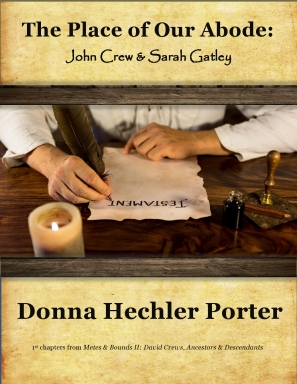
Cover Reveal & a Trailer for John Crew & Sarah Gatley

I've been so busy the past week, I find myself realizing I didn't do things at the oddest times.

Oh well, it gives me something to write about on my blog.

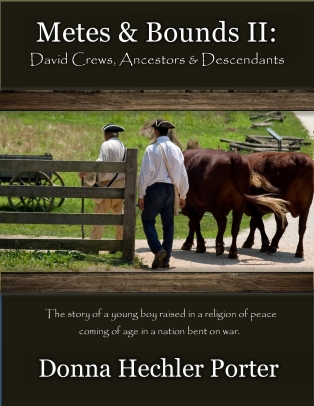
I am winding down the final editing changes for Metes & Bounds II: David Crews, Ancestors & Descendants. I decided this week to take the beginning chapters on John Crew & Sarah Gatley, the Stanleys, and David Crew and wives Mary Stanley and Mary Ladd-Magee (all of which are greatly expanded from the 1st edition published in the early 90s) and publish those in a smaller work which will be useful to descendants of John & Sarah, but who have no or only minimal interest in David Milton Crews.

For individuals descending from David Milton Crews, these chapters are included in the larger volume. It is not necessary to publish both books.

I also made the decision to published both volumes in a color version, and a black and white version.The black and white is so much cheaper, but the color version is a beautiful book.

I am still on target for a Thanksgiving 2014 release date, if not before. Below is the trailer for The Place of Our Abode: John Crew & Sarah Gatley. My trailers are also on my website, and ordering information is coming soon!


Monday, November 3, 2014

It's the Little Things!

It’s the little things that count!
I have this morning ritual. I eat egg burritos, hopefully have a clementine or something similar, and drink my coffee. (A perfect ritual involves coconut oil in the coffee, but right now it’s not perfect. Sigh . . . ) I eat, then crack open the laptop and check all my accounts.
Needless to say, this morning was super sweet because I have been in the hospital the past week with my son. We went to the ER exactly a week ago today with what turned out to be appendicitis. He had surgery Tuesday afternoon, but since it had turned gangrenous he had to have a drain and also IV antibiotics.
Needless to say, we were both glad to finally come home yesterday. After all, the hospital doesn’t serve egg burritos, and coffee in a styrofoam cup in a hard hospital chair just isn’t the same.
The little things. cowswithbars-page0001
I did manage, with so much time sitting, to finish the 2nd edition of Metes & Bounds II: David Crews, Ancestors & Descendants.
johncrewhalfcover-page0001
I also pulled the first chapters on John Crews and Sarah Gatley, and on his son David Crew and wives Mary Stanley and Mary Ladd-Magee, as well as the chapter on the Stanleys, to create another book. This book will be just for individuals who descend from Crew/Gatley and Crew/Stanley. Anyone descending from them through David Milton Crews (1740-1821) need not purchase the smaller edition as the chapters are in the larger work about his life and descendants.

I also debuted the trailer for Metes & Bounds II last night. 


I should have both books available the week of Thanksgiving. I will post here, on my Facebook page, as well as several other places when they are available. will ask, though, that if you purchase please go through my website which takes you to the publisher Createspace. Amazon literally takes 1/2 my profits.
Purchasing through Createspace is a little thing, yes, but it is the little things that count!

Tuesday, October 14, 2014

Columbus. Evil Genius? or A Man of His Time?

courtesy of www.freeimages.com
When I was a kid, Columbus Day was the next holiday after Labor Day. It meant another vacation day. The last before the Thanksgiving break almost six weeks away. That’s a long time for a kid.
We were taught in school that Columbus did a remarkable feat.
These days, not only is there an attempt to erase the man and the holiday from our history, but he’s being vilified as a slave trader and an Indian murderer with a heart more than willing to trade gold for humanity. He is being blamed for the decimation of all the Indian tribes in North, South, and Central America, even though he never set foot on the continent proper. He’s being blamed for the Europeans’ thirst for land and all the Indian wars in this nation from the time he landed in Hispaniola to those occurring in the latter part of the 19th century.
I really have to wonder what they are teaching children in school these days. They are obviously not teaching world history or the ability to think.
A few things Columbus did and did not do. First, he did not found America. He actually landed on Hispaniola, today’s Dominican Republic. He was the first man brave enough to set sail on the Atlantic Ocean. He was looking for a faster way to the West Indies, for hauling goods to Europe overland was tedious and costly. (Go read about Marco Polo and the Silk Road for more history on those trade routes.) No man was willing to take the risk, and Columbus even had trouble finding men to man his ships. The ocean was scary. It was big. His ships were small. There were bad storms and fearsome beasts. They didn’t have modern equipment that could get boats going when the wind lagged. There was no guiding equipment other than the direction of the sails. And no one had crossed it before. The Italian government was so aghast at the idea, Columbus, an Italian by birth, had to go elsewhere to get the funding. Queen Isabellah, a devout Catholic interested in spreading the Gospel of Christ, and her husband, King Ferdinand, wanting glory and riches for Spain, agreed to fund the expedition. (The Protestant Reformation did not occur until 1517.)
Regardless of what Columbus did or did not do afterwards, he had the bravery to haul off across the ocean to God only knew where. For that, alone, the man deserves his own holiday.  He changed the face of history forever. Prior generations understood this, maybe because they still had a sense of what it was like to have unexplored frontiers. Or perhaps they knew the fear of the unknown. At any rate, anyone with a basic understanding of maritime history will understand Columbus’ remarkable feat.
Columbus was, though, a man of his times. We all are. Don’t kid yourself. Our opinions, our approach to problems, our very goals are formed within the society that we live.  It seems, though, that we as Americans have become too soft. We expect people to act outside of their culture. We have no sense of how fraught world history is with suffering, annihilation, and brutality. The world has always been an ugly, unfair place, where the vast majority of us are pawns in the larger game of politics and the search for the power and wealth of the few.
Did Columbus enslave the Indians?  Sure he did. But, to be blunt, the history of the world is the history of victorious nations subduing conquered nations.  Every empire since the beginning of time, from the Mesopotamians to the Egyptians, to the Greeks, to the Romans, and on and on, went to war to gain more territory and killed and enslaved the conquered at will. In fact, the Romans enslaved the Britons (English) when they invaded England starting in AD 43. That’s 1,449 years before Columbus.  To expect Columbus to act contrary to his culture is just pure silliness. Men and women can only act so far out of the norm of whatever time period they live in. And it is clear, when world history is studied, that slavery has been a part of it since the beginning of time. Anyone living in 1492 would think nothing of it, and a conquered nation would expect it. Our history makes us too hyper-sensitive to even understanding slavery in the context of larger world history. We knee-jerk when the word is mentioned and can’t seem to think any farther back than the Civil War. We really need to buck up as a nation and deal with history realistically, the hard parts and the easy ones. We will be doomed to repeat it if we don’t.

823492_33877573
courtesy of www.freeimages.com
Did Columbus take the Indians’ land? Yes, at least in the Dominican Republic. The land of the Native Americans of North and South America? No. He never landed there. Did he pave the way for others to take their land? Yes, but let’s be realistic.  
It was only a matter of time before someone else ventured over the ocean and found this country.
Because countries want land and power, a race war was written in the cards for this nation from the very beginning.  If Columbus hadn’t started the chain reaction, someone else would have eventually, maybe sooner, maybe later, but it would have happened. To think the Indians would have been able to stay here and hang onto their way of life and land is absolutely ridiculous.
The politically correct mantra “we stole their land,” which seems to be in almost constant circulation these days is, of course, meant to make whites, or those with European backgrounds, feel guilty for changing the Indians’ culture forever. It’s a false, ridiculous charge, for in all honesty, those four words pretty much sum up all of human history. That’s the main reason nations go to war. It’s the main reason they have always gone to war. It’s the main reason cities “annex” land. To add to their tax base. To add to their political power.
So don’t blame the desire for land on Europeans or Americans. We didn’t come up with the idea. We were merely acting upon what had been done for thousands and thousands of years before. And for poor Columbus, the blame gets squarely laid at his feet, as if he hadn’t chosen to cross the ocean the Indians would have still been living peacefully on their land. Nothing could have been further from the truth.
And while we’re at it, let’s be clear about what kind of culture the Indians had. The Europeans first encountered the Native Americans in Central and South America, the Incas, the Mayans, and the Aztecs. All of these tribes practiced human sacrifice.  In fact, it was said their altars were always stained with blood.  The Europeans found this practice abominable. Did it take a war to rid the tribes of that practice? You bet. Should the war have been been waged?  You bet. The Aztecs, nor the others, were likely to give up their sacrifices to their own gods out of European reasoning. To think otherwise is just plain ridiculous. If explorers like Cortez had turned a blind eye to the practice would they then be judged for not doing enough? I’m afraid so. Some people are never happy no matter what decision a person makes.
And make no mistake about it, in this country, even before the Europeans landed, the Indians were not simply smoking peace pipes, loving each other in their tepees and longhouses, communing with wolves and eagles, and hugging trees. They were waging their own brutal wars against each other. They were taking each other’s land and enslaving each other. They forced prisoners from other tribes to run the gauntlet. They burned other Indians at the stake. They slit open the bellies of their enemies, both red and white, tied their entrails to stakes, and then laughed and jabbed at the victim with hot coals as he trotted and danced around the stake trying to escape the heat of the coals, his intestines unwinding as he did so. If the victim showed no fear, they might kill him sooner. The slightest whimper and they would find ways to make sure the victim didn’t die any time soon.
Was that hard to read? I hope so. Only then will you get an idea of the tribes encountered by the European settlers. Were there a few peaceful tribes? Yes, but the vast majority were brutal and bloodthirsty, and even the peaceful ones lived in fear of the more ruthless. They were not innocent in their dealings with each other, nor in their dealings with the colonists. Their inhumane practices started long before the Europeans arrived, so don’t blame them for the brutality. And please don’t say the Europeans brought those tortures with them and introduced them to the Indians. That is absolutely ridiculous. The records are rife with the horror the Europeans felt at such practices.  Had they known of such violence they would not have been so shocked.
The bald, flat out truth, which is largely ignored in favor of the more “politically correct” idea that the Indians were somehow innocent children who were grievously taken advantage of, is that if the Indians could have set aside their own grievances with each other they could have easily ousted the Europeans from the continent. The Indian Pontiac, in 1763, tried to do just that. He was unsuccessful, but he waged a bloody war all along the Pennsylvania-Virginia border before he was subdued.
The area of present day Kentucky is another example of not only the Indians’ failed attempt at rallying with each other, but at the wars they waged amongst themselves. This area was dubbed by the Indians themselves  as “the dark and bloody ground.” They, themselves, said the land ran “red with blood” from all the wars between the Indians that had taken place there. It was known clearly as no-man’s land among the tribes, because the tribes couldn’t agree on who should have it. By the 1750s, no one lived there. The long hunters easily made their way into the area, followed by Daniel Boone in 1774 and more settlers after that.  The Indians waged war after war to drive them out, but it was too late. The land had been vacant for too long because of the Natives’ own inability to come together and make a united front.
Why are the Native Americans not blamed for their part in their own failure to hang onto their land?  Personally, I think it’s because they have become the poster child for environmental issues and peace (which they didn’t even practice before the European came along). They are also propaganda tools for people who want to somehow discredit white European American contributions  to this country. After all, the squeaky wheel gets the most grease. If the grievances and untruths are constantly aired, people will believe that and not look deeper into the truth.  And if you make a country despise their history, then the people will accept whatever new ideas are foisted on them.
And why is this venom against Columbus so disturbing to me? Because it totally forgets the little person caught in the middle. I myself have a Jacobite rebel that was exiled and a possible Acadian ancestress that was exiled. I have at least one indentured servant in my background, and probably more. These individuals were given no choice about whether to come or not. They were the pawns in a much larger game. Once here they had to survive. If that meant killing Indians, they had no choice. If that mean moving west for more land because there was none left in the east, then so be it. Those choices were no different than my German ancestor who left the Rhine River in the 1800s to go to Russia for a better life.
It is grossly unfair to judge these people. We did not live in their time. Even the best person, with the most active imagination, can’t understand the society, culture, or world of someone in 1492, in 1550, 1620, 1800, or any other time.  We can seek to understand the political and social forces that drove them to make the decisions they did, but that is all. And we should not be judging those decisions as good or bad in light of our own culture. In fact, good historians do not do so. Political activists, with hidden agendas and who are willing to propagandize history to further their own ends, do.
youngdominicelizabeth3
Dominic & Elizabeth (Dietz) Hechler
We have a LOT to be proud of. My Jacobite ancestor, who would likely have been a chief in the Highlands, endured seven years of servitude on a tobacco plantation, chose to stay here rather than go back to Scotland, and eventually owned his own acreage. My ancestress, possibly an Acadian exile, married a Scotsman and made a life for herself after exiled from her home, and the Acadian exile was truly one filled with terror. 
I am profoundly moved by the decision of my Hechler ancestors to leave Russia in 1890 and to come to America, sight unseen, with nothing but the clothes on their back, in search of a better life. There was a reason people like them came. When did we as Americans lose sight of that? When did we forget the opportunities this nation provided, and still provides, to people? How can we overlook the fact that people are still flooding our borders legally and illegally? Why is it that these people want to be here, but we do not?  How is it that some people have become so ungrateful they can’t even look to the good, and vow to not repeat the bad, of past generations? Are we so shallow that we can’t look in two directions at once?  
As for the Native Americans, do I feel sorry for them? You bet. In fact, my heart breaks for them. But it also breaks for the Jacobites, for the Acadians, for the Irish immigrants of the potato famine, for the Jews and Christians killed in World War II, for the people in parts of our world today who live in brutal regimes under constant threat of slavery, imprisonment, or torture. The Indians were not the only ones disenfranchised and driven from their home land. They, alone, cannot be singled out for a mere struggle for survival that has been going on in nation after nation since the beginning of time.  Neither can Europeans be singled out and villified for doing what every empire before them has done.
I am proud of my family tree. I’m proud to say I hope their blood, filled with the ability to adjust to hardship, to shed despair, to forget the past and forge a future, runs through my veins freely and in massive quantities. Life is hard, brutal, and the human condition is frail. Life’s challenges require courage, fortitude, perseverance,  and the ability to make hard decisions. We all have to live within the culture and constraint of our times, just as the generations before us had to do, including men like Columbus. Nothing else is possible, for we only have so much control over the world we live in.  
We, as Americans, really need to move past the “or” of history and move to the “and.” History is not black or white, good or bad, completely right or totally wrong. It is black and white. It is good and bad. It is somewhat right and it is oftentimes wrong.  We can embrace both beliefs in whatever context we are studying. 
And we need to honor the Native Americans and their good alongside the Europeans and their good. We need to learn of the bad of the Native Americans and the bad of the Europeans.

Surely, it's not too late to teach our children to do both. Our nation’s very survival depends upon it.  


Friday, September 12, 2014

New Websites for Research

Well, I am either never on here, or I have a lot to say and post almost every day it seems!

I have three websites which some of you may be interested in.

For descendants of the Crews family that left Hanover, Henrico, Charles City, and New Kent Counties and headed south, David Crews and some others have a nice website called Wiregrass Genealogy. There are some nice family histories of various families, but there are a lot of Crews histories on their page. This family migrated to the South Carolina area around 1800. These families are connected to our own families that came to Kentucky having come from the Quaker families around Tidewater Virginia. Ours went west into Kentucky, and those branches went south.

Another website of interest that I have found is Genealogy Wise. It is chock full of resources, web pages, web page links (like to Facebook pages), etc. Great resource for anyone starting out on their genealogy adventure or who has been doing it for a number of years. I have met some Crews cousins through this website and am hopefully going to be the recipient of information to round out some of the lines for my second Metes & Bounds book that I would otherwise not have uncovered.

Third, I have created a Facebook for The Descendants of John McQueen & Nancy Crews. This is for all those lines that include and descend from the Barclays, Beans, Taylors, etc. I will be posting some snippets and facts as well as answering questions or exchanging information. My goal is to locate and/or reconnect with as many of John and Nancy's descendants as possible now that the 3rd book in my Metes & Bounds series is nearing completion. (I have had to push the publication back to early 2015.)