If you cannot get rid of the family skeleton, you may as well make it dance. George Bernard Shaw

Thursday, August 20, 2015


When, in the course of human events, did one nation infiltrate another and then seek to subvert the very culture of that country they were desperate to be a part of?

The answer?

Never, at least that I know of, until now.

America has long been called (unless it is no longer politically correct to do so) as the "great American melting pot." Anyone else remember the History Rock video of the same name (before videos were cool). A melting pot, of course, is a mish mash of different cultures coming together to form one. You could say it made us stronger and part of a whole, rather than weaker and separate.
youngdominicelizabeth3
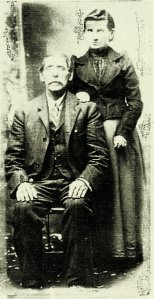
Probably Dominick Hechler and Elizabeth Dietz
My great-grandparents, Dominick and Elizabeth (Dietz) Hechler came to America from Russia (although they were 100% German - another story for another day) in 1890. I was told several times in asking stories of my family how they were PROUD to be here. They first landed at Castle Garden in New York (the forerunner of Ellis Island), but eventually ended up in Plantersville, Texas, with other families who had come with them. (I have written about them in my book I Will Go With You: The Hechlers, From Germany to Russia to America.)

The story was often told, but was told to me by Tilly Gaetz Hechler, wife of August Hechler who came with his parents from Russia, of how the school teacher came to my great-grandparents and told them they needed to start speaking English at home for the sake of the children. They were now Americans and lived in America and people here spoke English.  My great-grandfather, who around this time was also naturalized and became a US citizen,  did so. He was proud to be an American. He was grateful to be here, and he had no qualms speaking like an American and becoming part of the "melting pot" of this country. He even did so as he pressed for his oldest grandchild to be named Wilhelm, a very German name.

It is worthy of note, that my grandmother refused to do so. Was it calculated on their part for one to learn to speak English and the other to not so the children would learn both languages? Or did my great-grandmother simply refuse to learn for some reason? I do not know, nor is anyone alive who remembers. It was one of those questions one never ponders as a child, and then later it is too late to ask when it is thought of.
familyfortbend
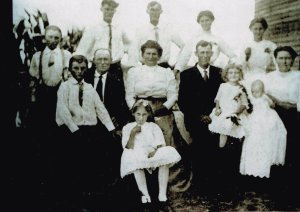
Dominick Hechler and Elizabeth Dietz family about 1915. My grandfather, D.J. Hechler, is sitting to the left on his father's knee.
Culture is more than the language a person speaks. Its their favorite foods, the folk music, oftentimes their ideas and religion. This is what homes are for. This is what parents and grandparents are for - to imbue a sense of the past into their offspring. If they choose to speak their native language at home, that is fine. But to come into a country and insist that country become bilingual is nonsense. They are not becoming a part of the "great melting pot," but setting up their own pot on a side burner.

I oftentimes heard stories of how my grandfather, D. J. Hechler, would go next door to the Wagners, another family that came with them from Russia, and how he and the older man would speak in German. And yet, my grandfather spoke English fluently as well. In fact, my grandmother, his wife, Eleanora Ressler Hechler, spoke English, but with her sisters spoke Czech. Neither one of my grandparents graduated high school, but they were bilingual. I cannot even boast of such skills today.

I have often heard the argument that immigrants do not wish to lose their identity as a culture. But why should they expect to leave their native land, come to another, and not lose something in the assimilation process? Did my great-grandfather, in coming here, give up his German roots? Sure, some. A person cannot move halfway around the world, or into another continent, and not lose something of their former way of life. Did my great-grandparents know this and chose that fate any way? Yes, because to stay in Russia was to continue to endure persecutions and the loss of their way of life. A loss that was harsher than moving to another country and becoming, in a sense, a hybrid of that culture.

But the thing of it is, they expected to do nothing so, for they were desperate to improve their lot and America offered them that chance. If America offers such a chance now to others, then those people who come should expect to be Americans, and that means learning OUR language, just like all other immigrants before them have done for hundreds of years.

That is what makes the melting pot strong.

Sunday, July 12, 2015

Elijah Crews Update


Elijah Crews was one of the older sons born to David Crews and Annie Magee. He was born in about 1765 in either Hanover or Bedford County, Virginia. He spent most of his early years in Bedford County and was about twelve years old when his father first went to Kentucky. In 1789 he married Susannah Dozier in Madison County, Kentucky. Susannah was the daughter of James J. and Martha Dozier.

In 1792, three years after his marriage, his father deeded him 200 acres on Otter and Silver Creeks. This property subsequently disappears from tax records, and in 1800, the Madison Court granted him permission to operate an ordinary (inn) out of his home. Tax records do not reflect his operation or ownership of an ordinary, however, so it is not known what happened to it.

By 1815, he had left Madison County and moved on to Hardin County, Kentucky.

In Metes & Bounds II: David Crews, Ancestors & Descendants, I stated that Elijah Crews died sometime after 1840. Mike Harris has located both the  settlement and probate papers in Hardin County Settlement Book G, page 374 (1830-1833) and Settlement Book I, Page 190 (1835-1837). 

Elijah died in 1833 at James Crews' house (possibly a son) and Elijah's son, David, executor of the estate, paid James $1.12 1/2 cents for bringing the body back home for burial. 

It had often been said by the children of David Crews' second wife, that the older sons by his first marriage drank too much and eventually lost the land their father had given them. It appears, perhaps, there is some truth to this statement, thanks to the research of Mike Harris, for Elijah Crews died in debt, and his widow, Susannah, was forced to buy back her furniture.

David Crews, in his will, stated about several of these older children, including Elijah, that he had "heretofore given all he intended giving" to them. Apparently, he meant it, for it does not appear he ever gave anything more to these children, despite the fact he was a very wealthy man at the time of his own death in 1821.

Elijah Crews's son, Squire Cruse, settled in Tyler County. Many of his descendants are listed in Metes & Bounds II: David Crews, Ancestors & Descendants, and some of my more recent blog posts are on this family. Again, thanks to Mike Harris for that information as well.

For a more extensive history of Elijah Crews, readers should refer to Metes & Bounds II.


Thursday, April 16, 2015

Segrest Cemetery, Tyler Couty, Texas


Mike Harris has been kind enough to also offer his pictures of the Segrest Cemetery. He visited that location in January of 2015. The cemetery is located about two miles east of the Cruse Cemetery. The graves of William Cruse, son of Squire Cruse and Piety Pruitt, and his wife, Hester Ann Segrest, are here, as well as the second husband of Hester, George Rich.

The son of the woman who currently owns the land which the cemetery lies upon maintains it by regular mowing. There are, sadly, a number of broken headstone in the cemetery from vandalization by kids about fifteen years ago. There has been no trouble recently. 

Wide Shot of Segrest Cemetery
William Cruse was born on 22 January 1835 in Jasper County, Texas, the first child born to Piety and Squire after the fateful drowning of five of their children in the Mississippi River on the way to Texas. (That event is detailed in Metes & Bounds II: David Crews, Ancestors & Descendants.) William married Hester Segrest, but at the young age of 24 he died from a severe case of big red measles. He and Hester had one daughter, Marinda Cruse, who was the second great grandmother of Mike Harris. 

.
Grave of William Cruse
Tombstone inscription:
He that followeth after righteousness, and
mercy find life, righteousness, and honor.
Grave of Hester Ann Segrest
wife of 1) William Cruse and 2) George Rich


.

Thursday, April 9, 2015

Cruse Cemetery, Tyler County, Texas, Part 5

There are several headstones in the Cruse Cemetery whose connections to the family are unknown.

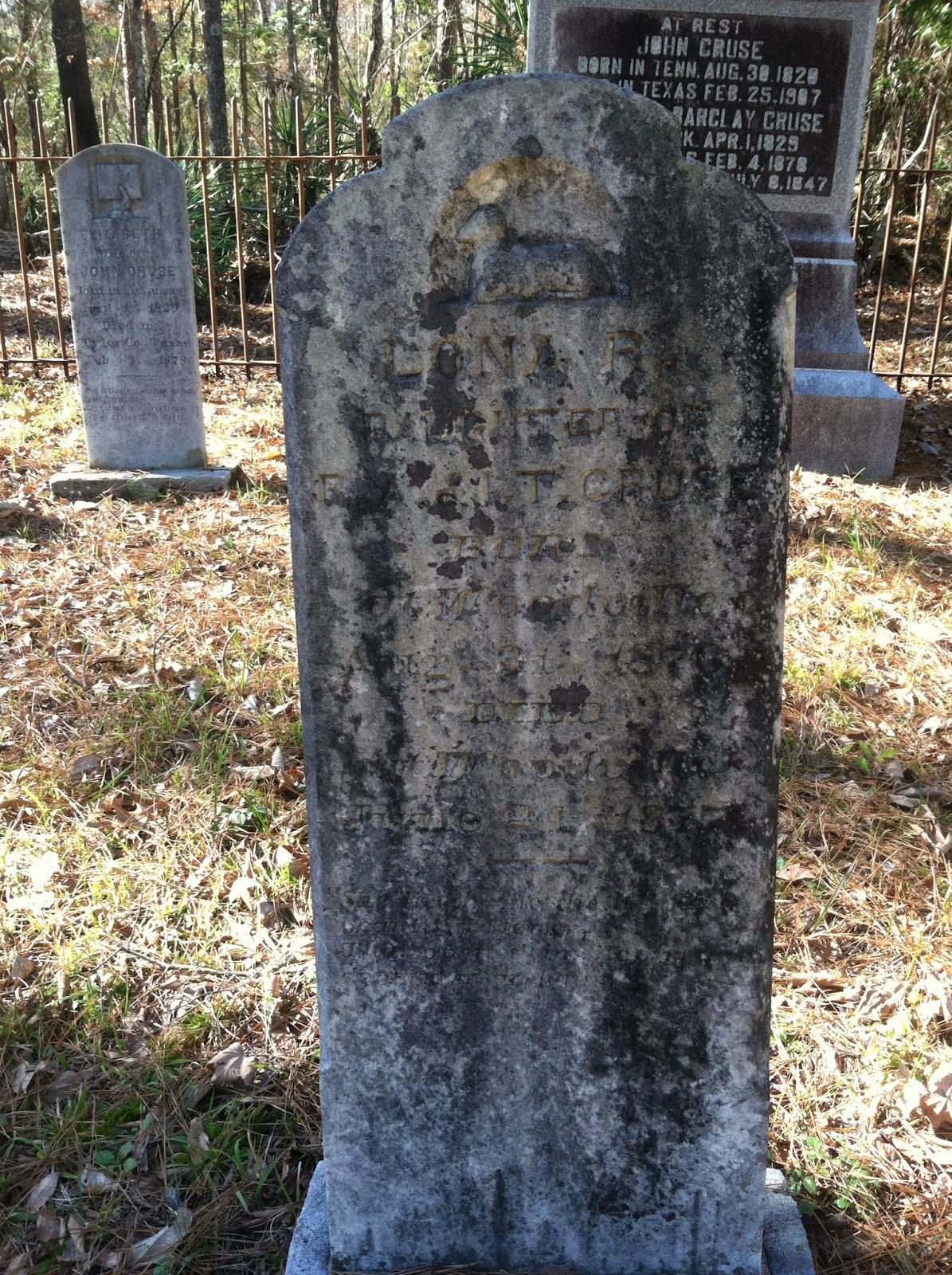
The first is the headstone of Lona Cruse. The inscription, which is difficult to read, seems to indicate she was a daughter of John and Elizabeth (Barclay) Cruse. However, she is not found on my information.

The second is the headstone of Walker Johnston.


The third is the headstone of Ida Belle Jernigan.


The fourth is the headstone of Jessie Walker.


Thursday, April 2, 2015

Cruse Cemetery, Tyler County, Texas Part 4


There are three more graves in the Cruse Cemetery with connections to the Cruse Family.

The first is Clementine "Clem" Cruse. She was was born on 15 May 1837 in Jasper County, Texas, to Squire and Piety (Pruitt) Cruse. She married William "Uncle Billy" Clark. William was born on 8 January 1820. He died at the age of 46, on 30 July 1866, of blood poisoning, not long after the Civil War. He was sitting with his family by the fireside one night. An open penknife was accidentally knocked from the fireplace mantle. It fell and cut his knee. He died a few months later of blood poisoning. Clementine outlived him by 27 years, passing from this life on 13 September 1893.


Josephine Collier was the first wife of Henry A. Cruse, who was the son of John and Elizabeth (Barclay) Cruse. She died in 1891 and Henry remarried Ada F. Bean, daughter of John Thomas "Jack" Bean and Narcissa Jane Fulghum. Both Henry and Ada were great-great grandchildren of David Crews and Annie Magee.

tombstone of Henry's first wife,
Josephine "Joe" Collier


Mattie Luciel Runnels was the daughter of Mary Ellender "Ella" Cruse and Jesse F Runnels, and the granddaughter of John and Elizabeth (Barclay) Cruse. She was born 2 September 1898 in Tyler County, Texas. At the age of four she became afflicted with intestinal complications and subsequently died on 16 September 1902.

Thursday, March 26, 2015

Cruse Cemetery, Tyler County, Texas, Part 3

Usually family cemeteries are not confined to just family members. The Cruse Cemetery is no exception.

Buried alongside the John and Elizabeth (Barclay) Cruse family are her parents, Robert Barclay and Sarah McKinsey.

Robert Barclay was the oldest son of Walter Barclay and Elizabeth McQueen. Robert was born on 12 November 1804 in Madison County, Kentucky. His paternal grandparents were Robert and Leah Barkley of Rowan County, North Carolina. His maternal grandparents were John and Nancy (Crews) McQueen. When he was about two years old, his parents left Kentucky for Tennessee, following the McQueens.

Sarah McKinsey was the daughter of Lacy McKinsey. She was born in 23 December 1808 in Kentucky. Her parents moved to Union County, Arkansas at an early date. Robert left Kentucky as a young man, met Sarah there, and married her.

About 1840 Robert and Sarah moved to Texas where he died in 1845. Sarah remained a widow, running their farm on her own with her slaves and her sons, until 1854 when she married widower Milton McQueen. Sarah is a controversial figure in McQueen-Barclay history. Beloved by some, she was hated by others. She was sued for slander by Narcissa Jane Fulghum (later wife of John Thomas "Jack" Bean) before the Civil War, accused of poisoning Milton McQueen, and was estranged from several of her sons in her later years.

Milton died in December of 1864 at the end of the Civil War. Sarah died on 11 October 1892 and was buried by her first husband in the Cruse Cemetery.


Tombstone of Robert Barclay

Tombstone of Sarah (McKinsey) Barclay - McQueen

Tombstone of Sarah (McKinsey) Barclay - McQueen

Thursday, March 19, 2015

Cruse Cemetery, Tyler County, Texas, Part 2

I have been deep in the throes of the last editing for my novel, Breaking Promises, so it has been difficult to get to genealogy for the moment. Hopefully, things will slow down here shortly and I can get back to posting on here.

I will continue posting pictures from Michael Harris that he took recently at the Cruse Cemetery. The pictures below are the tombstones of the family of John "Jack" Cruse, son of Squire Cruse and Piety Pruitt. He was the oldest child born to Squire and Piety, and the only child to survive the breaking apart of the Cruses' raft on the Mississippi River on the way to Texas. (He lost five younger brothers and sisters.)

John was born in Rutherford County, Tennessee on 30 August 1820 and came to Texas with his parents when he was thirteen years old.

John married Elizabeth Barclay, daughter of Robert Barclay and Sarah McKinsey on 8 July 1847 in Tyler County, Texas. Elizabeth was the great-granddaughter of John McQueen and Nancy Crews, and a great-great granddaughter of David Crews and Annie Magee. John Cruse's grandfather, Elijah Crews, was the brother of Nancy Crews, so he was the 3rd great grandson of David and Annie. Elizabeth's parents are also buried in the Cruse Cemetery (their pictures in the next posting).

Elizabeth was born 1 April 1829 in Arkansas. She came to Texas with her parents as a small child, but her father died not too long after their arrival. Her mother, Sarah, remarried to widower Milton McQueen in 1854.

There is a separate headstone in the Cruse Cemetery for Elizabeth, but at some point a large monument was erected directly behind hers that includes both Elizabeth and John. Elizabeth died in 1878, while John lived another 29 years, not passing from this life until 1907. It is likely the larger memorial was erected sometime after his death.

At least 3 of John & Elizabeth's children are buried in the Cruse Cemetery, all under the age of 9 at the time of their deaths.

Below you will find the pictures of the headstones of not only John and Elizabeth, but several of their children. Their daughter Clementine, however, will be in a separate posting.

This memorial for John Cruse and Elizabeth Barclay.  
Headstone for Elizabeth Barclay Cruse, wife of John "Jack" Cruse
Elias Cruse, son of John & Elizabeth (Barclay) Cruse, born 22 April 1863 and died 25 Aug 1863.
Elias was born during the Civil War and lived only four months. 

Elzira Cruse, daughter of John & Elizabeth (Barclay) Cruse, born 26 January 1856
and died at the age of 2 1/2 years on 29 Aug 1859.
 

Lacy M. (probably Milton) Cruse son of John & Elizabeth, born 8 Oct 1851
and died 2 Jan 1862 just as the Civil War started. He was 9 years old.